This blog documents the stories of of my ancestors who have had some military involvement. As the stories are not written in any specific order, below is a summary of those I've written or plan to write in alphabetical order, which I hope will make it easier for you to navigate the blog:
CONWAY, William John - Corporal, 7th Battalion, Black Watch, (Royal Highlanders), WWI
REEKS, John - Ordinary Seaman, Royal Australian Navy
I have two other blogs, DNA Discoveries, where I have documented some case studies about how I've used DNA techniques together with traditional research to solve some family history dilemmas and My Ancestors Stories where I share general family history stories.
I was recently issued with a commemorative Munition Worker's Veterans badge for front line duty by BAE Systems Heritage Department in recognition of the valuable work of my grandparents Helen Forrest McDougall and Robert Conway Martin at ICI Ardeer in Stevenston, Ayrshire during the Second World War.
Along with the badge, I was sent a copy of a letter from Her Majesty Queen Elizabeth II. Unfortunately the Palace has stated that the letter cannot be published, but the letter recognises "the remarkable courage and sacrifice of these individuals during a time of National Emergency".
The letter and badge were made available as the result of a campaign by the Munitions Workers Association over many years.
During the Second World War alone, there were over 3.5 million women who worked under the banner of Munitions, from shell production and filling to the construction of aeroplanes and tanks.
They endured gruelling shift patterns, exposure to toxins, and the threat that if they made an error during production it could cost the lives of the entire factory. Many women lost limbs, suffered with lung conditions for the duration of their lives, and lost babies who were stillborn due to the chemicals in which they worked.
After the War, the women were largely forgotten, their stories left untold. A forgotten army of millions. Their courage, sacrifice and determination provided the Armed Forces with the materials to win the war.
Nobel Industries Limited was founded in 1870 by Swedish chemist and industrialist Alfred Nobel for the production of the new explosive dynamite in the United Kingdom. Ardeer, on the coast at Ayrshire, was chosen for the company's first factory. The business later diversified into the production of blasting gelatine, gelignite, ballistite, guncotton, and cordite.
In 1926, the firm merged with several other companies creating a new group, Imperial Chemical Industries, then one of Britain's largest firms. Nobel Industries continued as the ICI Nobel division of the company.
Old Site Offices, Ardeer, ICI Nobel, Ayrshire Rosser1954, CC BY-SA 4.0, via Wikimedia Commons
ICI Ardeer was commonly known locally as the 'factory' or the 'Dinnamite'. At the time the company generally provided higher quality employment regarding terms and conditions and pension rights than other local firms. At its peak, the site employed almost 13,000 workers in a fairly remote location. The Ardeer site was its own community with enough employees on site that a bank, a travel agency, and a dentist were located on the site.
The former Western Scottish Bus Company provided tens of buses per day to transport the workers to and from the site, and until the mid-1960s, there were even two trains per day to transport workers to a station within the factory which was used solely for workers and any special visitors with business in the ICI plant, and was never a regular passenger stop. The abandoned platform remains, hidden beneath dense undergrowth.
Our family has had a long association with the factory since the early 1900s.
My great aunt, Caroline McDougall also worked as a munitions worker during the Second World War the following extract from a letter from her father to her sister in 1941 indicating that she was on the three to eleven shift. As Carrie lived in Glasgow, no doubt she used the private railway to travel to and from work.
Letter from Alexander McDougall to his daughter, Helen dated 3 April 1941
My grandfather, Robert Conway Martin was also working as a Explosives Worker at the time of his marriage to Helen in 1938 as was his father, James Martin. His sister, Sarah Martin was also described as an Explosives Worker at the time of her marriage to Harry Catt in 1945.
Marriage Certificate - Robert Conway Martin and Helen Forrest McDougall - 1938
My great grandfather, James Martin had worked at the ICI from at least 1911 when he is listed on the 1911 census with his sister, Lizzie McNeilly and her family. It is believed he and his brothers, John and William moved from Ireland to work at the factory.
James' father-in-law, Robert Conway (my 2 x great grandfather) was also recorded as a labourer at Nobel's Factory at the time of the 1911 census. He advanced to the position of foreman before his retirement.
Both Helen's parents, Alexander Murray McDougall and Caroline Anstey Garrett also worked as Explosive Workers at the time of their marriage in 1911.
Marriage Certificate - Alexander Murray McDougall and Caroline Anstey Garrett - 1911
The following video was released this week by Shifting Sands and is dedicated to all who served, in whatever capacity, at Nobel Explosives / ICI, during all wars. It shows some fascinating graffiti left - in pencil - by those who worked at the former Cordite "press hooses" on the old Nobel site during the Second World War.
(1925-1993) son of Arthur Samuel Rake and Clara Lillian Phibbs
George William RAKE was born on 28 November 1925 in Erskineville, NSW, Australia the only son of my paternal great grandparents, Clara Lillian PHIBBS and Arthur Samuel RAKE who were married on 24 Dec 1915 at St. Pauls, Sydney. George's father passed away when George was just 7 years old.
George enlisted in the Royal Australian Air Force Service on 4 Jan 1944 shortly after his 18th birthday. He did his basic training at Tocumwal, NSW and served at Cootamundra, NSW; Batchelor, NT; Morotai, Indonesia and Balikpapan, Borneo.
He was discharged 16 May 1946 as Leading Aircraftman with 24 Squadron. He was awarded the Pacific Star, War Medal 1939-1945 and the Australia Service Medal 1939-1945.
Cover of George's War Service Record National Archives of Australia
Upon his return from the war, George changed his name to Carl Drake. The clerk had a sense of humour!
He was an entomologist and a musician.
He married Rhoda Ada BEAVIS in 1956 in Chatswood, New South Wales.
George died on 12 November 1993 at the age of 67, and was buried in Northern Suburbs Crematorium, Sydney, New South Wales.
John Murray McDougall was born 2 Apr 1894 in Glasgow, the son of George Graeme McDougall and Martha Orr Campbell Murray, my 2 x great grandparents, who were married 24 Nov 1882 in Dalrymple, Ayrshire. The family moved to Glasgow shortly after their marriage. John was the second youngest of five children, he was just 2 years old when his mother, Martha died shortly after the birth of his younger brother in 1896.
Collingwood Battalion on Parade Gallipolli
John joined the Collingwood Battalion of the Royal Naval Division as an Able Seaman.
The Royal Naval Division landed at Cape Helles at the end of May 1915 and prepared for what is now known as the Third Battle of Krithia. Amongst their ranks were the sailors of the Collingwood Battalion.
On 4 June, the seven hundred strong Collingwood Battalion took part in the second phase of the attack. The Royal Naval Division advanced and captured the enemy front line but suffered heavy casualties. The Collingwood Battalion took over and seized the Turkish second lines four hundred yards further on. However, the neighbouring French troops were driven back by a counter-attack, leaving the Battalion's right flank exposed. Flanking fire caused devastating casualties amongst the Collingwoods, with over five hundred men killed or wounded, including 21 year old, John Murray McDougall.
ADM 242: Naval Casualties, Indexes, War Grave Rolls and Statistics Book, First World War
The Battalion withdrew but their casualties were so heavy that the Battalion disbanded with the survivors being attached to other Battalions as reinforcements.
Helles Memorial, Gallipoli
John is commemorated on the Helles Memorial, a Commonwealth War Graves Commission war memorial on the Gallipoli peninsula overlooking the Dardanelles.
This is a battle memorial for the whole Gallipoli campaign and a place of commemoration for Commonwealth servicemen who died there and have no known grave.
William John Conway, was born on 1 October 1895 in Belfast the eldest son of Robert Conway and Margaret Jane Moore, my 2 x great grandparents who were married on 9 February 1892 in Ballygilbert Presbyterian Church, Bangor, Down, Ireland. The family lived in nearby Conlig and also at 34 Well Street, Belfast before moving to Scotland (sometime between 1905 and 1908) where they lived at 13 Townhead Street, Stevenston, Ayrshire.
In the 1911 census, William, aged 15, was working as a cattle boy for John Matthews on Girthill Farm, Ardrossan. Before enlisting he was employed by J. Morrison & Sons, Stevenston, Bread and Pastry Manufacturers, where he was serving his time as a baker.
William joined the Royal Highlanders Black Watch and went to France on 20 September 1915 and served with the 7th Battalion. He was 22 when he was killed in action on 26 March 1918 during the German Spring Offensive. The 17 May 1918 edition of the Ardrossan and Saltcoats Herald reported that Corporal William John Conway was missing in action and later it was officially confirmed that he must be presumed to have been killed.
Arras Memorial, Pas de Calais, France
William has no known grave and is commemorated on the Arras Memorial in France and on the Conway family grave headstone in Bangor Cemetery, Down, Ireland.
Also commemorated on the family headstone are his grandfather William John Conway who died at Conlig on 15 May 1919 (aged 76); his grandmother Agnes Jane Conway who died at Conlig on 4 January 1922 (aged 70) and his blind uncle, Hugh Conway, who died at Conlig on 25 September 1918 (aged 43).
My grandfather, Alfred William Hails was born at Concord on 25 October 1918, the youngest of six children of Robert Hails and Emma Sarah Reeks who were married 6 February 1909 at Helensburgh, NSW, Australia. The family lived for a time on the south coast but had moved to Sydney by 1917.
Alf’s parents were divorced when he was 8 years old and he lived with his mother and siblings at Arncliffe. Alf was a textile worker and married my grandmother, Esther Rose Lillian Rake in 1935 when he was just 16 years old. They had two children.
Record of Service
Alf enlisted in the Royal Australian Navy just before the outbreak of WWII. He reported for duty on 27 Aug 1939 and was initially assigned to the Penguin II, the RAN's main naval base at Garden Island as an Able Seaman.
Able Seaman - Royal Australian Navy 27 Aug 1939 - 24 Oct 1945
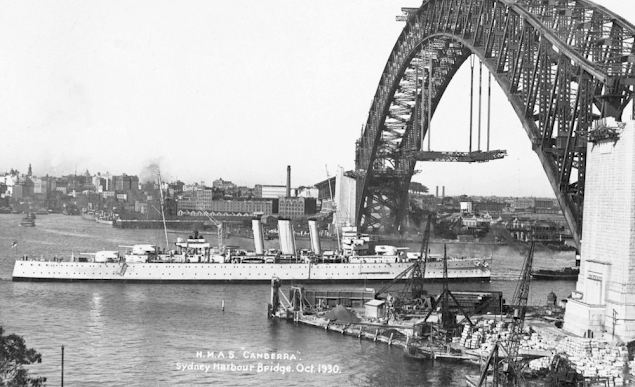
Alf served on HMAS Canberra from 29 Feb 1940 patrolling and escorting in home waters and the Tasman Sea. She later began a period of service in the Indian Ocean on escort duty from Fremantle to Colombo and Cape Town and was involved in several searches for various German vessels on the shipping routes leading from Africa to India and the Malay States.
HMAS Canberra, Sydney Harbour, Oct 1930
Following the outbreak of the Pacific War, the Canberra continued her role of escort cruiser, convoying troops to New Guinea and convoys to the Malayan / Java theatre.
HMAS Canberra was at anchor in Sydney Harbour on the night of the Japanese midget submarine attack on 31 May / 1 June 1942. Details of the attack and what happened afterwards are covered in this DigiTalk - The mystery of the M24 midget submarine by Sirling Smith, hosted by the Harbour Trust.
Alf, Back row, 5th from left
Two of the submarines were recovered several days after the attack and after analysis they were sent around New South Wales, South Australia and Victoria to raise money for the Royal Australian Navy Relief Fund and the King George Relief Fund for Merchant Sailors. People could pay to view the submarines, buy war bonds and souvenirs, such as lead models of the submarines. They were then sent to the Australian War Memorial and remains of the two submarines have been put together and are on display in the Anzac Hall. Alf participated in this tour and is pictured above.
HMAS Canberra supported the American landings at Guadalcanal and Tulagi, which ended with her loss in the Battle of Savo Island on 9 August 1942 when she was struck by two torpedoes. With power lost and the ship listing, the wounded and survivors were evacuated and the Canberra was then sunk by two American destroyers.
Of the 816 officers and men, casualties included 10 dead of wounds; 74 missing believed killed and 109 wounded.
Alf survived this encounter and later served on the HMAS Wagga and was demobbed on 24 Oct 1945.
Alf and Esther divorced during the war and he married again. After the death of his second wife, Alf reconnected with Esther and they married again in 1980 and remained together until Esther’s death in 2000.
Alf always participated in the Anzac Day marches while he was able. He died on 29 Dec 2009 in Westmead Hospital, when he was 91 years old.